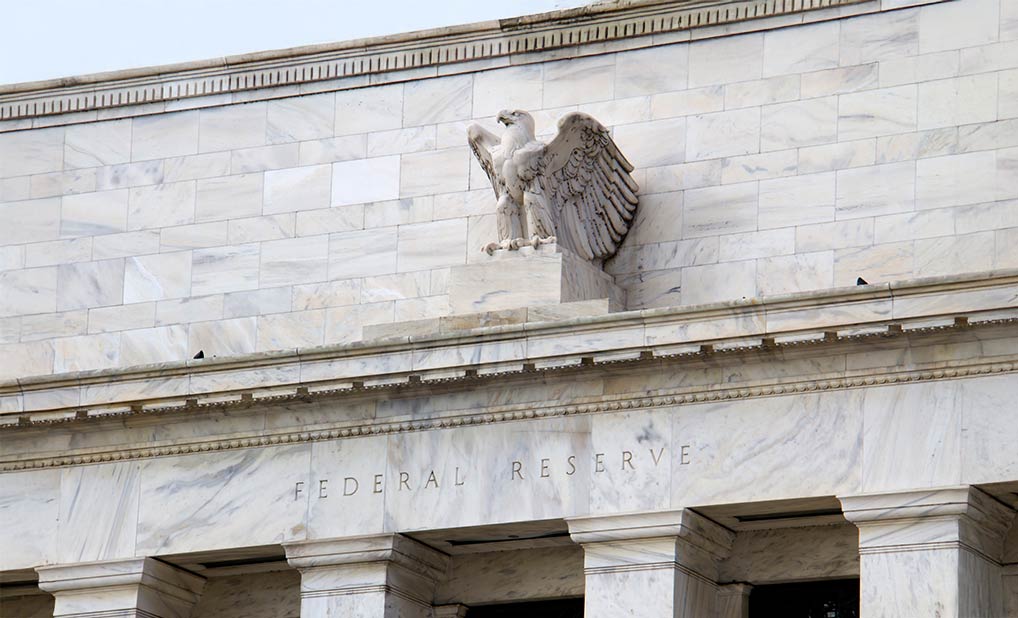

When Congress passed the Federal Reserve Act in 1913, it didn’t create a single centralized bank. Instead, it established the Federal Reserve System (Off-site), comprised of 12 Federal Reserve Banks, the Board of Governors, and the Federal Open Market Committee (FOMC). This structure ensures that financial power is shared across regions yet unified under one Federal Reserve System, a design that remains essential to U.S. monetary policy.
One System, many voices
Before the Federal Reserve, banking in America was fragmented, with frequent financial panics and no reliable lender. Lawmakers recognized that placing a single central bank in Washington D.C. or New York could favor one region over another. To build public trust, the new system needed both regional independence and national coordination, 12 banks working together as one.
Drawing the map of Federal Reserve Districts
In 1914, the Reserve Bank Organization Committee (RBOC) traveled across the country, holding hearings and reviewing thousands of proposals for potential Reserve Bank locations (Off-site). Each Reserve Bank needed a minimum capitalization of $4 million to be paid by member banks, and the idea was that eight to 12 banks would be established.
The RBOC considered regional trade and industry centers, transportation and communication routes, and existing banking activity. By May 1914, the committee designated 12 districts, each with its own Reserve Bank (Off-site). This network remains largely unchanged today and allows the Federal Reserve to operate close to the communities it serves while remaining unified under the Board of Governors in Washington, D.C.
The 12 Federal Reserve Banks
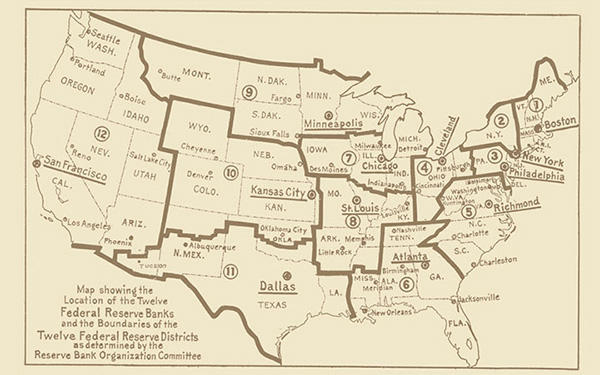
Along with the Board of Governors and the FOMC, the Federal Reserve System includes 12 regional banks (Off-site): Boston, New York, Philadelphia, Cleveland, Richmond, Atlanta, Chicago, St. Louis, Minneapolis, Kansas City, Dallas and San Francisco. Each district was strategically placed to reflect the country’s economic diversity. For example, New York emerged as the hub for financial markets, Minneapolis was tasked with serving the Upper Midwest, and San Franscisco’s vast territory covers the West Coast and Alaska. Together, these districts ensure that every region of the United States has a voice in shaping national monetary policy and reflected the diverse economic landscape of early 20th century America.
Balancing local insight and national policy
Each Reserve Bank gathers economic data, supervises financial institutions and engages with local communities. This information flows into national discussions. All 12 districts contribute to setting monetary policy using their local expertise to shape national decisions, allowing regional differences to be represented, and enabling the Fed to remain responsive to Main Street and Wall Street.
12 Banks, one mission
More than a century later, the structure of the Federal Reserve System still serves its purpose (Off-site). In today’s era of digital banking, instant payments and global markets, the 12 Federal Reserve Banks function as independent yet interconnected pillars of the U.S. financial system. They ensure that monetary policy reflects the voices of every region, maintaining stability and trust across the nation. What began as a response to 19th century banking crises has evolved into a modern network of independent yet interconnected banks, each bringing regional insight to a unified mission: supporting a healthy U.S. economy.